Water damage restoration in Brampton & the GTA.
A leak, flood, or appliance failure needs a fast response to protect your floors and prevent mould. We assess on-site and move quickly to extract water before it causes lasting damage.
24/7 Emergency Water Extraction Process
Why every hour matters after a leak or flood.
Water damage is one of the few household issues where speed genuinely determines the outcome. In the first few hours after a leak, burst pipe or appliance failure, water is typically still contained to carpet, padding and the immediate surface. Extraction at this stage can often fully save the carpet and prevent damage spreading to the subfloor. Left untreated for 24-48 hours, that same water begins wicking into walls, baseboards, and subflooring, and conditions become favourable for mould growth, which is both a health concern and significantly more expensive to remediate than water extraction alone. This is exactly why we take calls 24/7 rather than only during business hours — a burst pipe on a Saturday night can't wait until Monday morning without meaningfully worse outcomes.
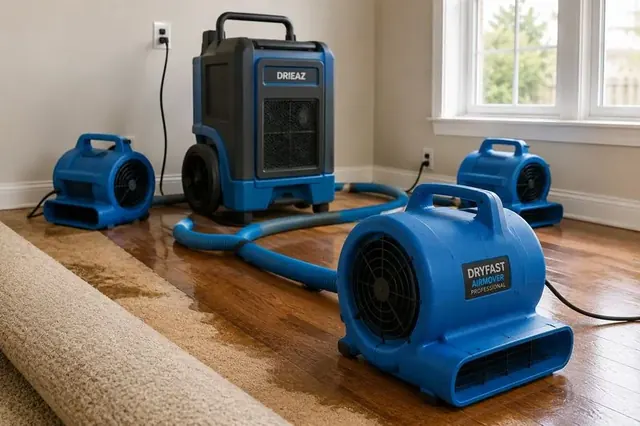
Our response uses the same category of equipment as dedicated restoration companies. Commercial-grade air movers create rapid airflow across wet surfaces. Dehumidifiers pull moisture out of the air itself, so surfaces can actually dry rather than staying damp in humid air. Air movers alone, without dehumidification, can actually slow drying in a small enclosed room, by raising humidity faster than they can evaporate surface moisture. That is why we assess the room and pair the right combination of equipment to the space and the severity of the intrusion.
Why every situation gets an in-person assessment.
Unlike routine carpet cleaning, water damage restoration can't be accurately quoted over the phone. The severity varies enormously based on factors that aren't visible from a description alone. How long the water has been sitting. Whether it has reached the subfloor. How large an area is affected. And what type of water is involved — clean supply-line water versus contaminated water from a sewer backup, which needs different handling entirely. We assess in person before quoting so the plan actually matches the real situation, rather than under-scoping a job that turns out to need more extensive drying, or over-scoping a smaller, more contained leak.
Working with your insurance.
Many water damage situations — burst pipes, appliance failures, sudden leaks — are covered under standard homeowner's insurance policies, though coverage details vary by policy and provider. We document the work performed, including photos of the affected area and the equipment deployed, which is often needed to support an insurance claim. We'd still recommend contacting your insurance provider as early as possible after discovering water damage, since many policies have specific requirements around timely reporting and mitigation steps.
What happens after the water is gone.
Extraction and structural drying are the urgent first steps, but they're often not the final one. Once the affected carpet and surrounding area are fully dry, we typically recommend a full carpet cleaning to address any residue left behind, particularly if the water involved anything other than clean supply water. Where carpet or padding has been saturated for an extended period before we're called in, replacing the padding, and sometimes the carpet itself, may be the more realistic outcome. We'll always be honest about that during assessment, rather than trying to save materials that are genuinely beyond restoring.
See the difference.
What to Do Before We Arrive
Call first — 437-873-3116, any hour — then work through this while you wait. None of it requires equipment. There is a longer version of it in what the first 24 hours after a flood actually decide, including what not to move.
- Stop the source if you safely can. The shut-off valve under a sink or behind a toilet, or the main if you cannot find it. If the water is coming from a burst supply line, this is the single thing that changes how big the job gets.
- Treat standing water as an electrical hazard. Do not walk into it if it is near outlets, a furnace or a panel. If water has reached the electrical panel, stay out of the room and call your utility before anyone else.
- Lift what you can. Furniture legs onto blocks or foil, area rugs off the wet carpet, anything on the floor up onto something dry. Wooden furniture legs will stain wet carpet within hours.
- Do not use a household vacuum. A shop vac rated for water is fine. A regular vacuum is not, and it is a genuine shock risk.
- Photograph everything before you move it. Insurers ask, and the photos are easier to take now than to explain later. Keep any part that failed — the burst hose, the cracked fitting.
What Can Usually Be Saved, and What Cannot
This is the first question almost everyone asks, and the honest answer depends on two things: what kind of water it was, and how long it sat.
Clean water, caught early. Water from a supply line, a tap or a fridge line is the best case. Carpet is often salvageable when extraction and drying start within the first day or two — that is why we answer the phone at any hour rather than booking you in for Tuesday.
The underpad is a different story. The cushion under the carpet is built to be soft and absorbent, which makes it very good at holding water and very bad at giving it back. Even after clean-water damage it usually has to come out, because it stays wet long after the carpet above it feels dry. We will tell you when that is the case rather than charge you to dry something that needs replacing.
Water that has sat, or water that was not clean. The longer it sits the worse the odds, and water that has been through a drain or come up from outside is a different category of problem altogether. That is also where our limit is: we do the extraction and the structural drying, and where remediation is needed we bring in licensed restoration contractors who work to the industry guidelines. What we do and do not do is set out in full.
What the training actually is. Kharl Reynolds is trained to the IICRC's Water Damage Restoration Technician standard, known in the trade as the WRT. The IICRC is the body that sets the training standard for this work. The WRT is the part of it that covers water: how the category of the water changes what can be saved, how fast materials have to be dried, and how to read a moisture meter instead of guessing. It is a certification held by a person, not a badge bought by a company.
If you are not sure which of these you have, call and describe it. We would rather talk you through it on the phone than have you guess.
Burst pipes, condo losses and commercial water damage.
A burst pipe is the fastest-moving of these because the volume does not stop until the supply is shut off. If it is safe to do so, closing the valve is the single most useful thing anyone can do before we arrive; after that, the clock on what can be saved is running rather than waiting.
Condo water damage is rarely confined to one unit. Water finds its way down through the structure, so a single failed hose upstairs can affect three units and a shared corridor, and the building usually gets involved before the restoration does. Service elevator windows, a certificate of insurance on file and notice to the board are routine, which is why giving us the building name on the call saves a day. The city pages for Mississauga and Toronto go into that in detail.
Commercial water damage adds a second clock: the business needs the space back. Drying equipment has to run continuously to work, so the realistic conversation is usually about which areas can be closed off and for how long, rather than whether the equipment can come out early. It cannot, and pulling it early is the most common route to a mould problem three weeks later.
Frequently asked.
How quickly should I act after a leak or flood?
As soon as possible — ideally within 24-48 hours. The longer water sits in carpet and padding, the higher the risk of mould growth and permanent damage to flooring and subfloor.
Can my carpet be saved after water damage?
It depends on the water and the timing. Carpet soaked by clean water — a supply line, a tap, a fridge line — can often be saved if extraction and drying start within the first day or two. The underpad underneath usually cannot; it holds water long after the carpet feels dry and generally has to come out. Water that has sat for days, or that came from a drain or from outside, is a harder case and sometimes not worth drying at all. We will tell you which one you have rather than charge you to dry something that needs replacing.
What should I do while I wait for you to arrive?
Stop the water at the shut-off valve if you can reach it safely, and stay out of standing water that is near outlets, a furnace or the electrical panel. Lift furniture legs off the wet carpet and take up any area rugs, because wooden legs stain wet carpet within hours. Do not use a household vacuum on water. Photograph everything before you move it, and keep whatever failed — your insurer will ask for both.
Why can't you give a price over the phone?
Water damage severity varies enormously based on the source, how long water has been sitting, and what materials are affected. Those are also what decide how many drying days the job needs, which is the part that moves the number most. An on-site assessment lets us give you an accurate, fair quote instead of a rough guess, and the assessment itself is free: we look at it and give you a figure before any work starts.
Do you work directly with insurance companies?
We can provide documentation of the assessment and work performed that you can submit to your insurance provider. Contact us to discuss your specific situation.
Ready to book?
Free, no-pressure quotes — most jobs quoted same day.
Real reviews from real customers.
Feedback from homeowners across Brampton, Mississauga, and the GTA West.
Water damage, stage by stage and city by city.
A loss runs in stages and each one has its own page. Emergency water extraction covers the first hours, when bulk water comes out. Structural drying covers the days after it, metered daily rather than guessed. Flood cleanup is the same work at larger volume.
What changes between cities is the housing, and what gets in the way of starting. In Brampton finished basements are the pattern. In Mississauga the building decides when work can begin. In Toronto access and a second decision-maker slow the first hour. In Caledon a hose simply will not reach.